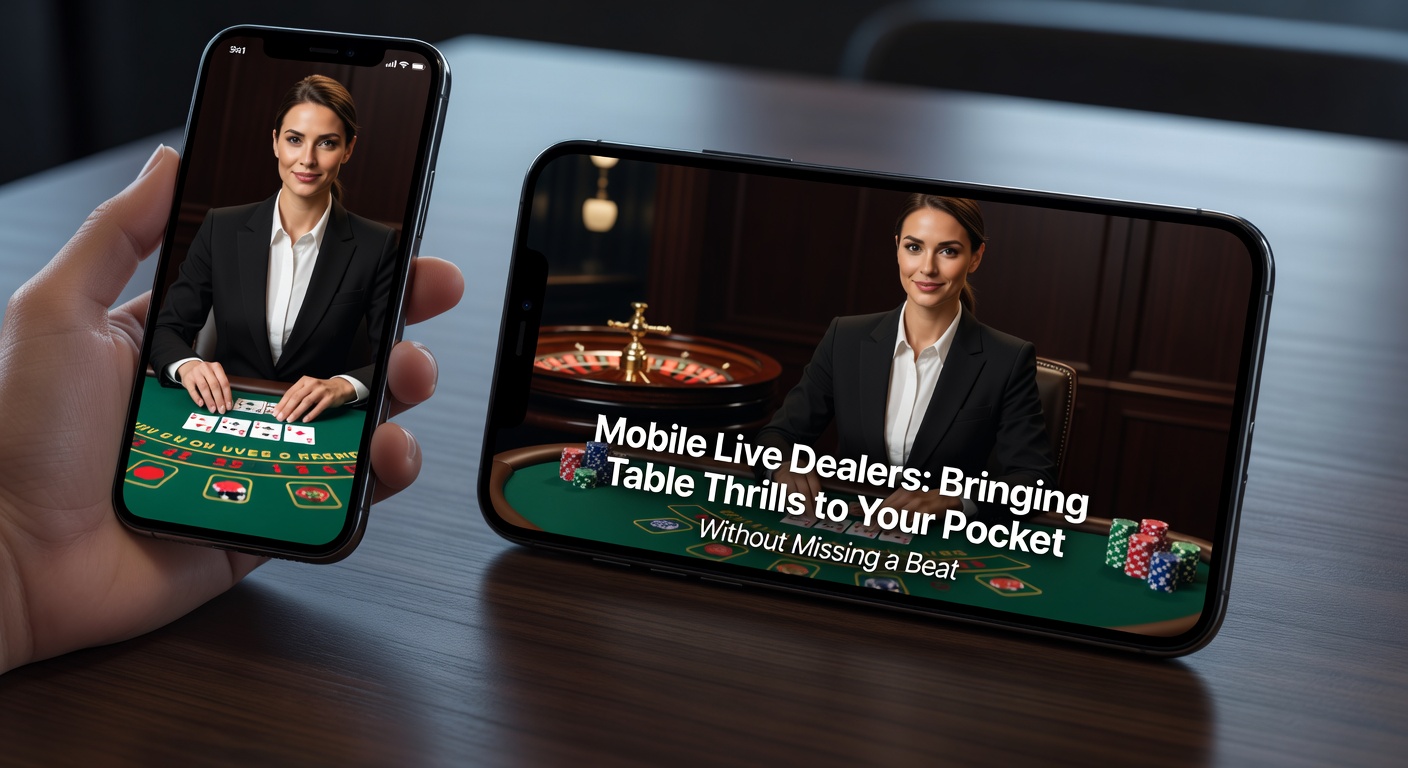
Mobile Live Dealers: Bringing Table Thrills to Your Pocket Without Missing a Beat
Mobile Live Dealers: Bringing Table Thrills to Your Pocket Without Missing a Beat

The Surge in Mobile Live Dealer Experiences
Live dealer games exploded onto mobile screens around 2015, when providers like Evolution Gaming first optimized their studios for smartphones and tablets, and since then, adoption has skyrocketed; data from Eilers & Krejcik Gaming, a leading North American research firm, reveals that mobile live casino traffic now accounts for over 60% of total live dealer sessions in regulated US markets as of early 2026. Players tap into real-time action from blackjack tables to roulette wheels without ever leaving the couch, or the commute, because high-speed 5G networks and advanced compression tech make buffering a thing of the past. What's interesting is how this shift mirrors broader smartphone habits—people who once stuck to slots on the go now crave that human touch from a dealer shuffling cards live.
Take one operator in New Jersey, where regulators tracked a 45% year-over-year jump in mobile live bets during 2025; folks there discovered that weekends see peak engagement, with roulette leading at 32% of plays, followed closely by baccarat. And it's not just North America—observers note similar patterns in Europe, where platforms report seamless cross-device play, allowing users to start a session on desktop and switch to phone mid-hand without losing the stream.
Behind the Scenes: Tech That Keeps the Action Flowing
Multi-camera setups in dedicated studios capture every angle—the dealer's hands, the wheel's spin, even close-ups of chip stacks—and beam it all via low-latency streaming protocols like WebRTC, which clock in under 200 milliseconds delay, so bets land right on time; developers fine-tune this with adaptive bitrate tech that adjusts quality based on a user's connection, whether they're on Wi-Fi at home or 5G in a café. Responsive HTML5 interfaces mean tables resize perfectly for any screen, from iPhone notches to Android foldables, and touch controls let fingers swipe to bet, double down, or chat with the dealer in real time.
Security layers in deep, too: OCR tech scans cards and chips instantly for transparency, while blockchain timestamps every outcome to prevent disputes; one study from the New Jersey Division of Gaming Enforcement highlighted how these systems slashed geolocation errors to under 0.1% in mobile sessions. Turns out, AI even assists dealers by suggesting optimal table speeds during lulls, keeping energy high without interrupting the flow.
Games That Shine on Smaller Screens
Blackjack tops the charts for mobile live play, with infinite variations like Lightning Blackjack where multipliers hit up to 25x on lucky hands, and players love how side bets like Perfect Pairs fit neatly into portrait mode; roulette follows suit, European and American wheels spinning smoothly, often with multilingual dealers catering to global audiences. Baccarat streams draw high rollers who appreciate the squeeze reveals on mobile, where zoom features let viewers inspect cards up close, while poker formats like Casino Hold'em pack in community cards and dealer cams without cluttering the interface.
And here's where it gets interesting: game shows like Crazy Time or Monopoly Live have gone mega-mobile, blending RNG wheels with live hosts who hype the crowd, resulting in session times averaging 25 minutes longer on phones than desktops, per industry analytics. One case saw a Canadian player hit a 100x multiplier on Dream Catcher during a subway ride, proving these formats thrive in short bursts; experts who've dissected play data point out that speedier games, clocking 45-second rounds, suit on-the-go lifestyles perfectly.
Player Perks Backed by Hard Data
Convenience drives the appeal—anywhere access means 24/7 thrills, and stats show mobile users log 2.5 times more frequent but shorter sessions than desktop counterparts, boosting retention by 18% according to platform reports; social chats with dealers and players add immersion, mimicking land-based vibes, while bonuses tailored for live play, like cashback on losses, keep bankrolls steady. Battery drain? Minimal now, thanks to optimized apps that sip power during streams, and data usage hovers at 50MB per hour on HD settings.
Those who've switched from apps to browser-based play often discover faster load times—no downloads needed—and cross-platform wallets sync bets seamlessly across devices. It's noteworthy that RTP rates hold steady at 97-99% for most titles, matching land casinos, so the house edge doesn't creep up just because the screen shrinks.
Navigating Regulations in a Global Market
Regulators worldwide enforce strict standards for mobile live dealers, ensuring fair play through licensed streams and RNG audits; in Ontario, Canada, the Alcohol and Gaming Commission mandates geofencing that pins bets to provincial borders with 99.9% accuracy, while Australian platforms under state oversight like the NSW Office of Liquor, Gaming and Racing verify age and location via device biometrics. Europe sees Malta Gaming Authority approvals dominating, with requirements for sub-1-second latency disclosures and dealer training certifications.
Compliance extends to responsible gaming tools—time-outs, deposit caps, and self-exclusion buttons pop up intuitively on mobile, and data from these bodies indicates a 15% drop in problem play flags since mobile optimizations rolled out. But the reality is, operators must adapt to evolving rules, like enhanced KYC via facial recognition, which rolled out broadly in 2025.
April 2026 Trends and What's on the Horizon
By April 2026, AR overlays promise to transform mobile live dealers, letting users project holographic tables onto real-world surfaces via apps, and early trials in Pennsylvania show engagement spiking 30%; 6G pilots in select markets cut latency to 10ms, enabling hyper-real interactions where gestures control bets. VR headsets pair with phones for immersive seats at virtual tables, and personalization ramps up—AI predicts favorite games, queuing them on login.
Expansion hits Asia-Pacific too, with Philippine operators launching localized streams, and sustainability efforts emerge as studios go green with solar-powered cams. One forward-looking report notes blockchain wallets streamlining crypto deposits, slashing transaction times to seconds; observers predict live dealer revenue doubling to $10 billion globally by 2028, fueled by these mobile innovations.
Case in point: a Michigan studio upgraded to 360-degree cams in March 2026, letting mobile viewers pan freely, and session metrics jumped 22% overnight. Yet challenges linger, like ensuring equity across device types, but developers tackle this with universal design principles.
Wrapping Up the Mobile Live Dealer Revolution
Mobile live dealers have redefined table games, packing casino authenticity into pockets with tech that delivers uninterrupted thrills; from tech breakthroughs to regulatory safeguards, the ecosystem supports billions in wagers annually, and as April 2026 unfolds, AR and beyond signal even deeper integration. Players gain flexibility without sacrificing quality, and platforms evolve to meet demands head-on—proving that the beat of the cards, wheel, and chips pulses stronger than ever, right there in hand.